Monday, October 23, 2017

National Geographic Photo of the Day: October 23rd of 2017

Picture of a participant in Coney Island's Mermaid Parade

October 23, 2017

Mermaid Parade
Since 1983, Coney Island in Brooklyn, New York, has thrown a Mermaid Parade as a celebration of the start of summer. More than 1,500 people dress in elaborate, artistic costumes, traveling through the neighborhood and along the boardwalk. In this photograph, a participant poses for a portrait.

Guardians of the Galaxy Music on Vynil


Guardians of the Galaxy Deluxe Vinyl Edition

Astronomy Picture of the Day: October 23rd of 2017

See Explanation.
Moving the cursor over the image will bring up an annotated version.
Clicking on the image will bring up the highest resolution version
available.
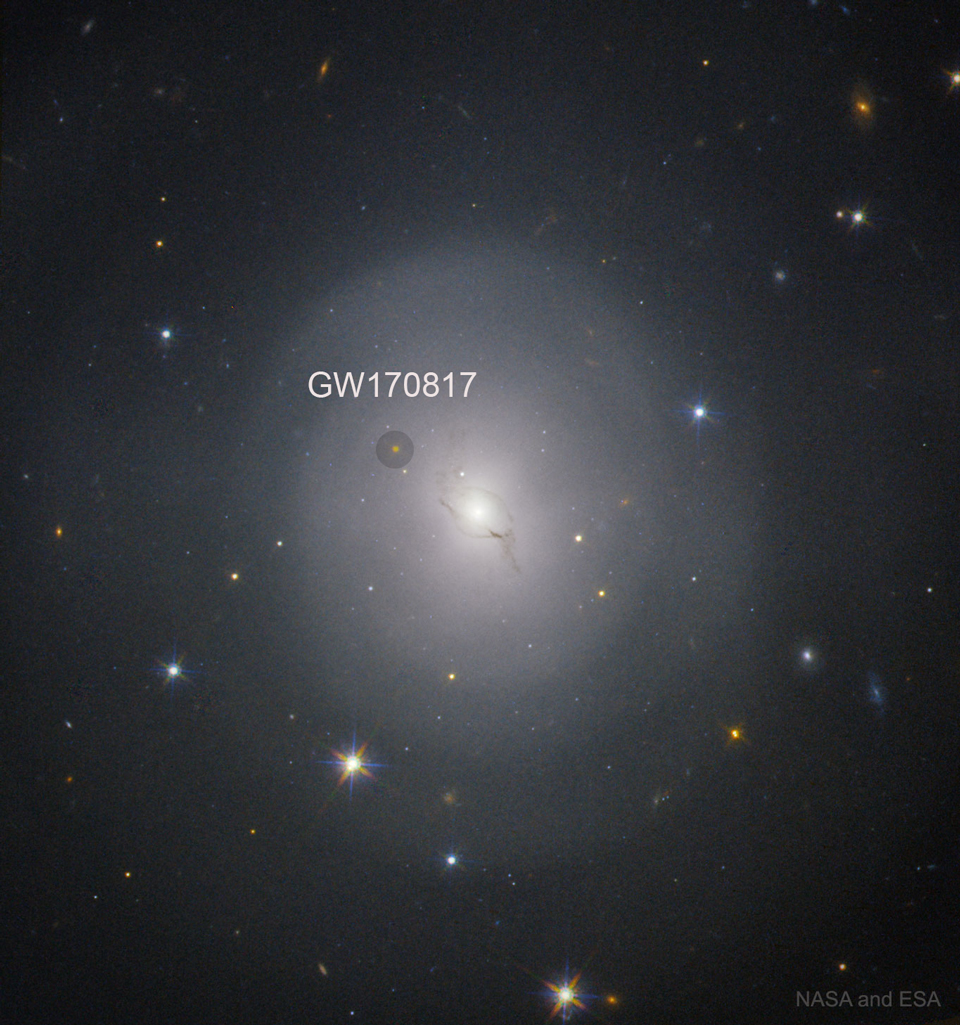
NGC 4993: The Galactic Home of an Historic Explosion
Image Credit: NASA & ESA
Explanation: That reddish dot -- it wasn't there before. It's the dot to the upper left of galaxy NGC 4993's center, do you see it? When scanning the large field of possible locations of an optical counterpart to the unprecedented gravitational wave event GW170817 in August, the appearance of this fading dot quickly became of historic importance. It pinpointed GW170817's exact location, thereby enabling humanity's major telescopes to examine the first ever electromagnetic wave counterpart to a gravitational wave event, an event giving strong evidence of being a short gamma-ray burst kilonova, the element-forming explosion that occurs after two neutron stars merge. The featured image of lenticular galaxy NGC 4993 by Hubble shows the fading dot several days after it was discovered. Analyses, continuing, include the physics of the explosion, what heavy elements formed, the similarity of the speeds of gravitational radiation and light, and calibrating a new method for determining the distance scale of our universe.

Sinatra Vynils


Ultimate Sinatra [2 LP]

Sunday, October 22, 2017

National Geographic Photo of the Day: October 22nd of 2017

Picture of a freediver swimming by an artificial reef shaped like an elephant

October 22, 2017 The ReefIn the Red Sea off the coast of Egypt, a freediver swims near an artificial reef shaped like an elephant. As coral reefs around the world are threatened, artificial reefs can be a boon to the underwater ecosystem, and an artistic take on one provides added enjoyment to underwater enthusiasts.

Cool USB Solar Charger

Astronomy Picture of the Day: October 22nd of 2017

See Explanation.  Clicking on the picture will download
 the highest resolution version available.
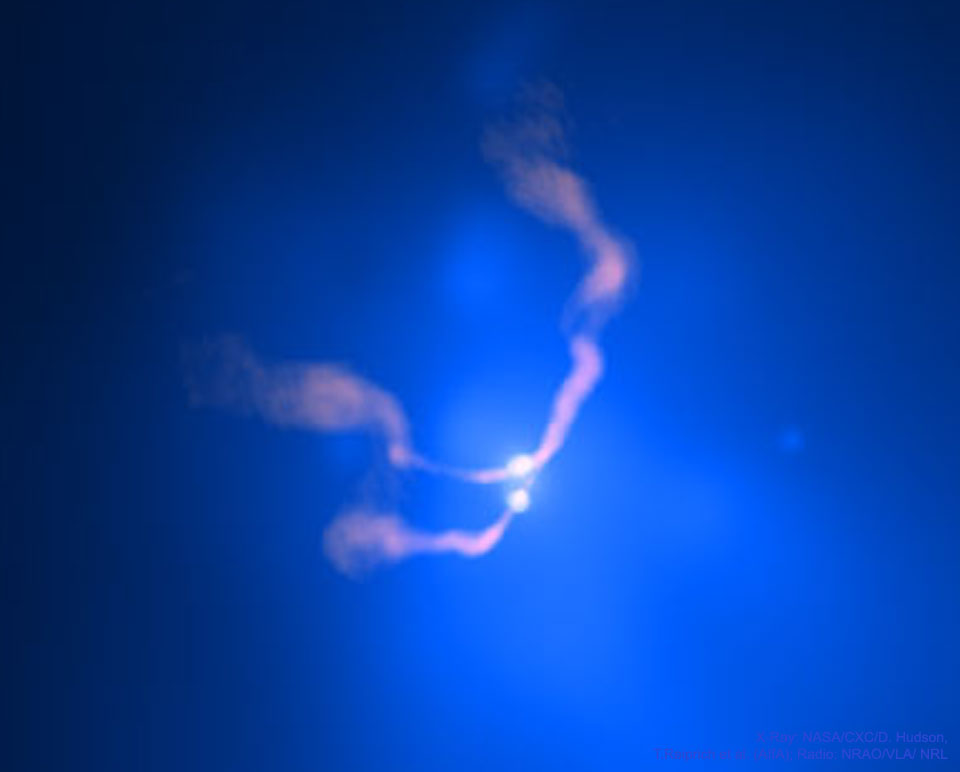
Two Black Holes Dancing in 3C 75
Image Credit: X-Ray: NASA/CXC/D. Hudson, T. Reiprich et al. (AIfA); Radio: NRAO/VLA/ NRL
Explanation: What's happening at the center of active galaxy 3C 75? The two bright sources at the center of this composite x-ray (blue)/ radio (pink) image are co-orbiting supermassive black holes powering the giant radio source 3C 75. Surrounded by multimillion degree x-ray emitting gas, and blasting out jets of relativistic particles the supermassive black holes are separated by 25,000 light-years. At the cores of two merging galaxies in the Abell 400 galaxy cluster they are some 300 million light-years away. Astronomers conclude that these two supermassive black holes are bound together by gravity in a binary system in part because the jets' consistent swept back appearance is most likely due to their common motion as they speed through the hot cluster gas at 1200 kilometers per second. Such spectacular cosmic mergers are thought to be common in crowded galaxy cluster environments in the distant universe. In their final stages the mergers are expected to be intense sources of gravitational waves.

Cool LED Lightbulb

Tuesday, August 29, 2017

National Geographic Photo of the Day: August 29th of 2017

Picture of rooftops in Varanasi, India

August 29, 2017
Morning Rooftops
Day begins in Varanasi, the holiest city in India for Hindus. Located on the banks of the holy river Ganges, millions of pilgrims visit each year to bathe in the sacred waters. "Being the oldest continuously inhabited city in India, Varanasi is chaotic and colorful, intense and frenetic," says Your Shot photographer Yan Li. "Although it is the holiest place for Hindus, the daily life of locals has no difference compared to ours."

Astronomy Picture of the Day: August 29th of 2017

See Explanation.  Clicking on the picture will download
 the highest resolution version available.

Saturn in Blue and Gold
Image Credit: Cassini Imaging Team, SSI, JPL, ESA, NASA
Explanation: Why is Saturn partly blue? The featured picture of Saturn approximates what a human would see if hovering close to the giant ringed world. The image was taken in 2006 March by the robot Cassini spacecraft now orbiting Saturn. Here Saturn's majestic rings appear directly only as a thin vertical line. The rings show their complex structure in the dark shadows they create on the image left. Saturn's fountain moon Enceladus, only about 500 kilometers across, is seen as the bump in the plane of the rings. The northern hemisphere of Saturn can appear partly blue for the same reason that Earth's skies can appear blue -- molecules in the cloudless portions of both planet's atmospheres are better at scattering blue light than red. When looking deep into Saturn's clouds, however, the natural gold hue of Saturn's clouds becomes dominant. It is not known why southern Saturn does not show the same blue hue -- one hypothesis holds that clouds are higher there. It is also not known why Saturn's clouds are colored gold. Next month, Cassini will end its mission with a final dramatic dive into Saturn's atmosphere.

Monday, June 19, 2017

Coal: Last Week Tonight with John Oliver (HBO)

what

Flat Belly Detox

36-Year Old Husband Uses One Simple Trick to Improve His Health
No one ever thought a friendly hormone inside your body could turn bad so quickly…
A faulty glitch in one of your most powerful organs…
Sends this fat-storing fluid straight into your blood stream.
And before long, the damage is already done.
What’s worse is the effects come on slowly, so you’ll never feel a thing.
While your pancreas keeps misfiring massive amounts of this “heavy hormone” forcing you to store belly fat at a faster rate…
No matter how many fruits and vegetables you eat.
Hi, my name is Josh and just a short time ago…
A horrifying family photo on a trip to a bird park in Tennessee with my wife ignited the shocking spark that led to one of the BIGGEST breakthroughs in the health and weight loss world for men and women with 15 or more pounds to lose…
A discovery so rare…
Overall, I melted away 110 pounds and 26 inches from my belly and waist without a single struggle when NOTHING ever worked for me before...
That’s right, 110 pounds of PRESSURE lifted OFF my knees, back, and joints...
Going from THIS…
TO THIS…

More info Click Here!

National Geographic Photo of the Day: June 19th of 2017

Picture of blue and white marble caves in a lake

June 19, 2017
Marble Caves
Las Cuevas de Mármol (The Marble Caves) sit in the middle of General Carrera Lake, which lies between Chile and Argentina. The tunnels and caves are only reachable by boat. The swooping arches have been formed by more than 6,000 years of water lapping against the rock, and the waters change color depending on the time of year.

Astronomy Picture of the Day: June 19th of 2017


Eclipse Across America: Path Prediction Video
Video Credit: NASA GSFC's Scientific Visualization Studio; Blue Marble data courtesy Reto Stöckli (NASA/GSFC)
Explanation: Where will you be during the Eclipse across America? On August 21, the shadow of the Moon will cross the continental USA for the first time since 1979. The predicted path -- a certainty given modern astronomical knowledge -- is shown in the featured NASA video. Most people in the USA will be within a day's drive to the path of the total solar eclipse, while the rest of North America will see a partial solar eclipse. In the path of totality, given clear-enough skies, the Moon will block out the Sun making it eerily dark for as long as 2 minutes and 40 seconds. If interested in attending an eclipse party, please contact your local amateur astronomical society, science center, park, or university to see if one is already being planning. Some eclipse chasers have traveled to the end of the world to see a total eclipse of the Sun, and along the way have recorded many entertaining adventure stories.

Tuesday, May 30, 2017

National Geographic Photo of the Day: May 30th of 2017

Picture of skateboarders on a ramp

May 30, 2017
Morning Grind
Skateboarders start their day on a ramp in Los Angeles. Your Shot photographer Corban Lundborg says that for him, skateboarding is more than a hobby: "The traffic jams in Los Angeles cause many to look for alternative modes of transportation."

Astronomy Picture of the Day: May 30th of 2017

See Explanation.
Moving the cursor over the image will bring up an annotated version.
Clicking on the image will bring up the highest resolution version
available.
A Kalahari Sky
Image Credit & Copyright: Petr Horálek
Explanation: You wake up in the Kalahari Desert in Botswana, Africa. You go outside your tent, set up your camera, and take long exposures of the land and sky. What might you see? Besides a lot of blowing dust and the occasional acacia tree, you might catch many sky wonders. Pictured in 2015 September, sky highlights include the central band of our Milky Way Galaxy, the Pleiades Star Cluster, Barnard's Loop, and both the Large and Small Magellanic Clouds, to name just a few. Although most of these faded in the morning light, they were quickly replaced by a partial eclipse of the Sun.

Monday, May 29, 2017

National geographic Photo of the Day: May 29th of 2017

Picture of a bird and cherry blossoms in Japan

May 29, 2017
Hello, Spring
A bird inspects the offerings of a cherry tree before all the blossoms are in full bloom. Every spring, the iconic trees, known as sakura, usher in Japan's busiest tourist season.

Astronomy Picture of the Day: May 29th of 2017

See Explanation.  Clicking on the picture will download
 the highest resolution version available.
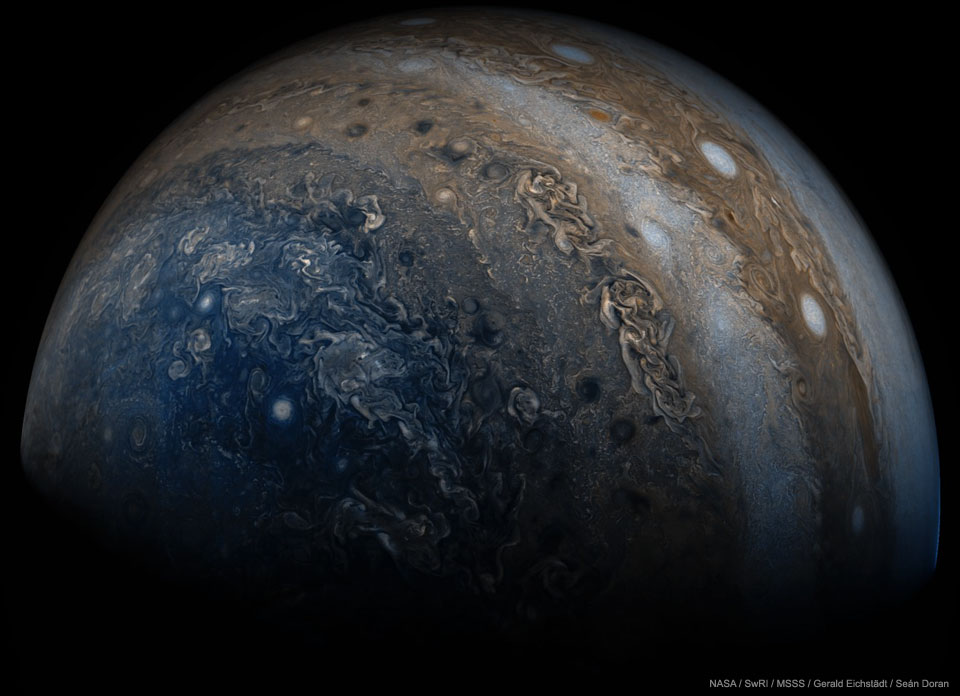
Beneath Jupiter
Image Credit: NASA, Juno, SwRI, MSSS, Gerald Eichstädt & Seán Doran
Explanation: Jupiter is stranger than we knew. NASA's Juno spacecraft has now completed its sixth swoop past Jupiter as it moves around its highly elliptical orbit. Pictured, Jupiter is seen from below where, surprisingly, the horizontal bands that cover most of the planet disappear into swirls and complex patterns. A line of white oval clouds is visible nearer to the equator. Recent results from Juno show that Jupiter's weather phenomena can extend deep below its cloud tops, and that Jupiter's magnetic field varies greatly with location. Juno is scheduled to orbit Jupiter 37 times with each orbit taking about six weeks.

Saturday, May 27, 2017

These 5 Censored Books Tell a History the Establishment Wants Hidden

National Geographic Photo of the Day: May 27th of 2017

Picture of goatherd in the snow in Turkey

May 27, 2017
Follow the Leader
A goatherd treks through the snow in Beysehir, Turkey. According to the Food and Agriculture Organization of the United Nations, there are 65.5 million goats and sheep in Turkey-- which works out to about 215 goats per square mile.

Astronomy Picture of the Day: May 27th of 2017

See Explanation.  Clicking on the picture will download
 the highest resolution version available.
Comet Clark is near the Edge
Image Credit & Copyright: Raul Villaverde Fraile
Explanation: Sweeping through this stunning field of view, Comet 71P/Clark really is in the foreground of these cosmic clouds. The 2 panel telescopic mosaic is color enhanced and is about 5 degrees (10 full moons) across. It captures the faint comet's position on the night of May 23/24 over 5 light-minutes from Earth, very near the line-of-sight to bright star Antares and the Rho Ophiuchi cloud complex. In the frame Antares, also known as Alpha Scorpii, is at bottom center surrounded by a dusty cosmic cloud reflecting the cool giant star's yellowish light. Globular star cluster M4 shines just right of Antares, but M4 lies some 7,000 light-years away compared to Antares' 500 light-year distance. Slightly closer than Antares, Rho Ophiuchi's bluish starlight is reflected by the dust in molecular clouds toward the top. You can spot the small coma and short tail of the comet as a faint smudge near the center of the left edge of the frame. Just look for the comet's striking greenish color, produced as diatomic carbon molecules fluoresce in sunlight.

Friday, May 26, 2017

National Geographic Photo of the Day: May 26th of 2017

Picture of brick worker in Bangladesh

May 26, 2017
Bearing the Load
In Bangladesh, a worker in a brickyard carries stacks of bricks out from the kiln. The nation is growing rapidly, and the need for construction materials is constant.

Astronomy Picture of the Day: May 26th of 2017

See Explanation.  Clicking on the picture will download
 the highest resolution version available.
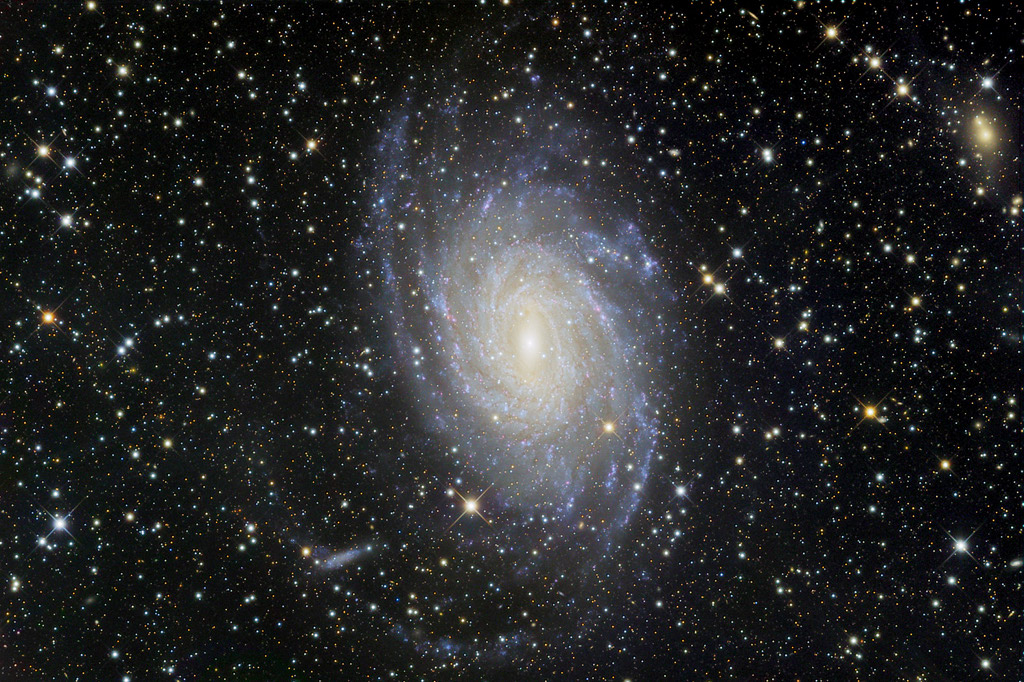
Spiral Galaxy NGC 6744
Image Credit & Copyright: Daniel Verschatse
Explanation: Big, beautiful spiral galaxy NGC 6744 is nearly 175,000 light-years across, larger than our own Milky Way. It lies some 30 million light-years distant in the southern constellation Pavo appearing as a faint, extended object in small telescopes. We see the disk of the nearby island universe tilted towards our line of sight. This remarkably distinct and detailed galaxy portrait covers an area about the angular size of the full moon. In it, the giant galaxy's yellowish core is dominated by the light from old, cool stars. Beyond the core, spiral arms filled with young blue star clusters and pinkish star forming regions sweep past a smaller satellite galaxy at the lower left, reminiscent of the Milky Way's satellite galaxy the Large Magellanic Cloud.

Thursday, May 25, 2017

National Geographic Photo of the Day: May 25th of 2017

Picture of schools of sharks in the Galápagos

May 25, 2017
A Swarm of Sharks
Your Shot photographer Kimberly Jeffries was scuba diving in the Galápagos Islands when dozens of scalloped hammerhead sharks began swimming above her. "Without the use of video lights or strobes it was challenging to shoot straight up," she recalls, "but we didn't want to disturb the sharks with flashes. It's beautiful to witness nature in its untouched and wild form like this."