Showing posts with label picture. Show all posts

Sunday, October 22, 2017

Astronomy Picture of the Day: October 22nd of 2017

See Explanation.  Clicking on the picture will download
 the highest resolution version available.
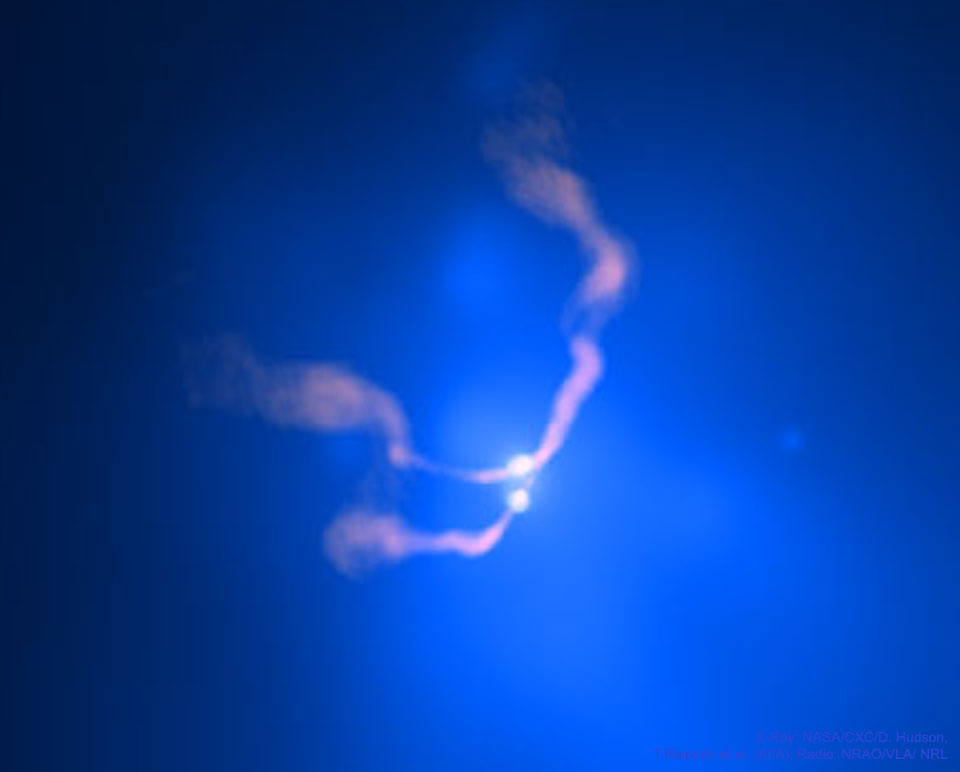
Two Black Holes Dancing in 3C 75
Image Credit: X-Ray: NASA/CXC/D. Hudson, T. Reiprich et al. (AIfA); Radio: NRAO/VLA/ NRL
Explanation: What's happening at the center of active galaxy 3C 75? The two bright sources at the center of this composite x-ray (blue)/ radio (pink) image are co-orbiting supermassive black holes powering the giant radio source 3C 75. Surrounded by multimillion degree x-ray emitting gas, and blasting out jets of relativistic particles the supermassive black holes are separated by 25,000 light-years. At the cores of two merging galaxies in the Abell 400 galaxy cluster they are some 300 million light-years away. Astronomers conclude that these two supermassive black holes are bound together by gravity in a binary system in part because the jets' consistent swept back appearance is most likely due to their common motion as they speed through the hot cluster gas at 1200 kilometers per second. Such spectacular cosmic mergers are thought to be common in crowded galaxy cluster environments in the distant universe. In their final stages the mergers are expected to be intense sources of gravitational waves.

Monday, August 3, 2015

Astronomy Picture of the Day: August 3rd of 2015

See Explanation.  Clicking on the picture will download
 the highest resolution version available.
A Proton Arc Over Lake Superior
Image Credit & Copyright: Ken Williams
Explanation: The setting had been picked out -- all that was needed was an aurora. And late last August, forecasts predicted that an otherwise beautiful night sky would be lit up with auroral green. Jumping into his truck, the astrophotographer approached his secret site -- but only after a five hour drive across the rural Upper Peninsula of Michigan. What he didn't know was that his luck was just beginning. While setting up for the image, a proton arc -- a rare type of aurora -- appeared. The red arc lasted only about 15 minutes, but that was long enough to capture in a 30-second exposure. As the name indicates, proton arcs are caused not by electrons but by more massive protons that bombard the Earth's atmosphere following an energetic event on the Sun. In the featured image, the yellow lights on the horizon are the city lights of Marquette, Michigan, USA. The blue and yellow rocks in the Lake Superior foreground are lit by a LED flashlight. Also captured, to the left of the red proton arc, was the band of our Milky Way Galaxy.