Showing posts with label apod. Show all posts

Monday, November 13, 2017

Astronomy Picture of the Day: November 13th of 2017

See Explanation.  Clicking on the picture will download
 the highest resolution version available.
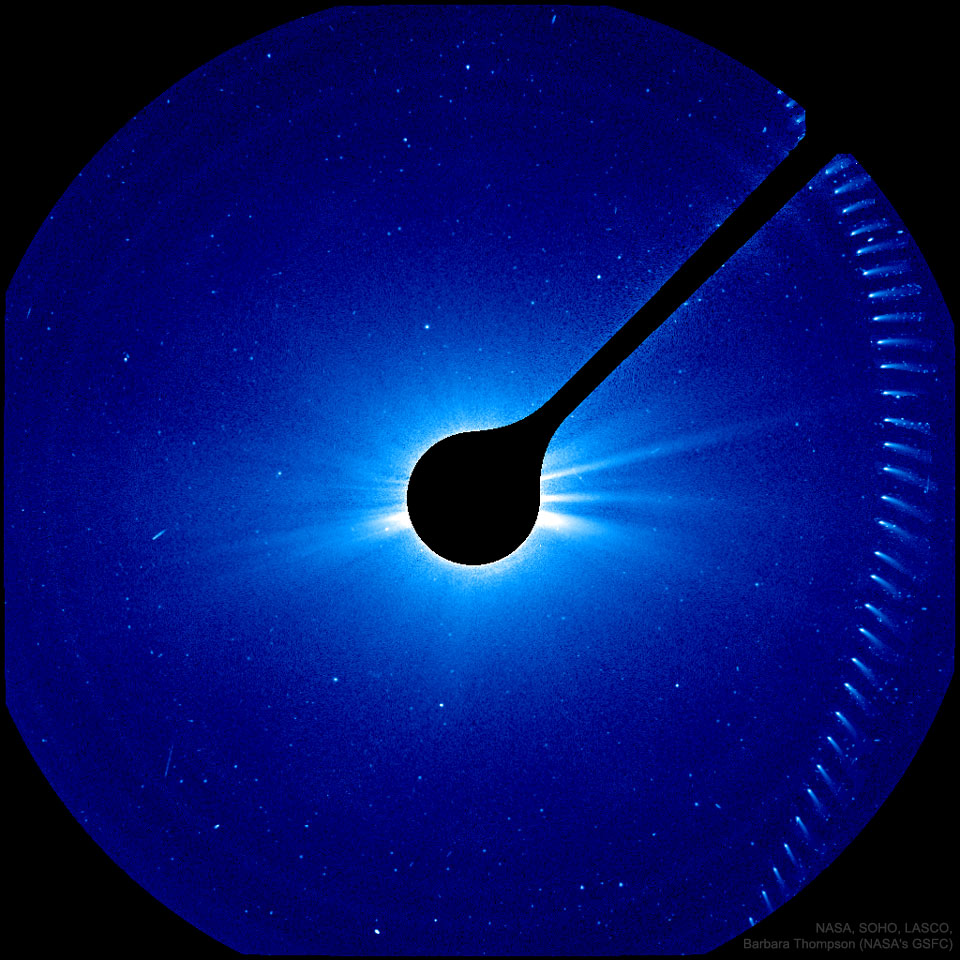
Comet Machholz Approaches the Sun
Image Credit: NASA, SOHO, LASCO, Barbara Thompson (NASA's GSFC)
Explanation: Why is Comet Maccholz so depleted of carbon-containing chemicals? Comet 96P/Machholz's original fame derives from its getting closer to the Sun than any other short period comet -- half as close as Mercury -- and doing so every five years. To better understand this unusual comet, NASA's Sun-monitoring SOHO spacecraft tracked the comet during its latest approach to the Sun in October. The featured image composite shows the tail-enhanced comet swooping past the Sun. The Sun's bright surface is hidden from view behind a dark occulter, although parts of the Sun's extended corona are visible. Neighboring stars dot the background. One hypothesis holds that these close solar approaches somehow cause Comet Machholz to shed its carbon, while another hypothesis posits that the comet formed with this composition far away -- possibly even in another star system.

Saturday, November 11, 2017

Astronomy Picture of the Day: November 11 of 2017

See Explanation.  Clicking on the picture will download
 the highest resolution version available.
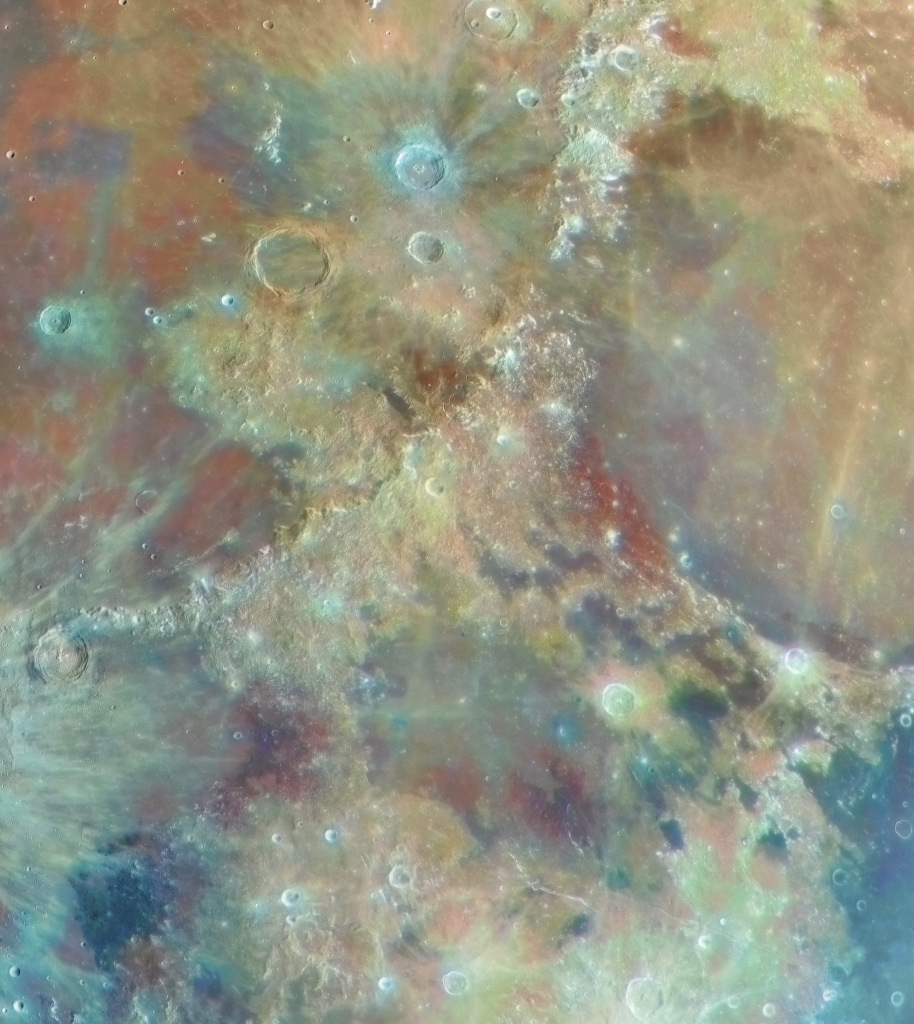
A Colourful Moon
Image Credit & Copyright: Alain Paillou
Explanation: The Moon is normally seen in subtle shades of grey. But small, measurable color differences have been greatly exaggerated in this mosaic of high-resolution images captured near the Moon's full phase, to construct a multicolored, central moonscape. The different colors are recognized to correspond to real differences in the mineral makeup of the lunar surface. Blue hues reveal titanium rich areas while more orange and purple colors show regions relatively poor in titanium and iron. The intriguing Sea of Vapors, or Mare Vaporum, is below center in the frame with the sweeping arc of the lunar Montes Apenninus (Apennine Mountains) above it. The dark floor of 83 kilometer diameter Archimedes crater within the Sea of Rains, or Mare Imbrium, is toward the top left. Near the gap at the top of the Apennine's arc is the Apollo 15 landing site. Calibrated by rock samples returned by the Apollo missions, similar multicolor images from spacecraft have been used to explore the Moon's global surface composition.

Tuesday, November 7, 2017

Astronomy Picture of the Day: November 7th of 2017

See Explanation.  Clicking on the picture will download
 the highest resolution version available.
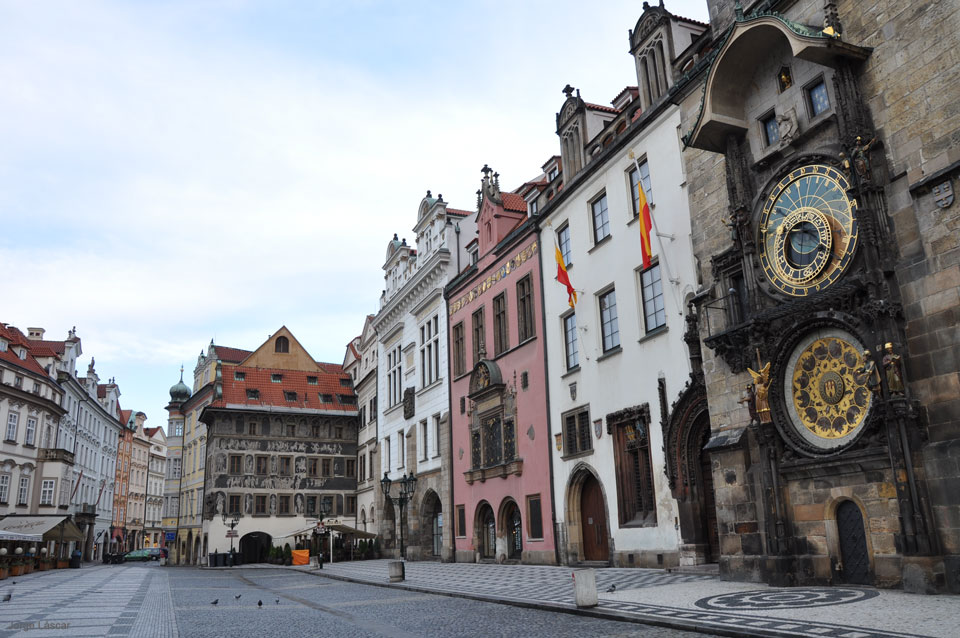
The Prague Astronomical Clock
Image Credit & License: Jorge Láscar
Explanation: In the center of Prague there's a clock the size of a building. During the day, crowds gather to watch the show when it chimes in a new hour. The Prague Astronomical Clock's face is impressively complex, giving not only the expected time with respect to the Sun (solar time), but the time relative to the stars (sidereal time), the times of sunrise and sunset at several latitudes including the equator, the phase of the Moon, and much more. The clock began operation in 1410, and even though much of its inner workings have been modernized several times, original parts remain. Below the clock is a nearly-equal sized solar calendar that rotates only once a year. Pictured, the Prague Astronomical Clock was photographed alone during an early morning in 2009 March. The Prague Astronomical Clock and the Old Town Tower behind it are currently being renovated once again, with the clock expected to be restarted in 2018 June.

Monday, November 6, 2017

Astronomy Picture of the Day: November 6th of 2017

See Explanation.  Clicking on the picture will download
 the highest resolution version available.
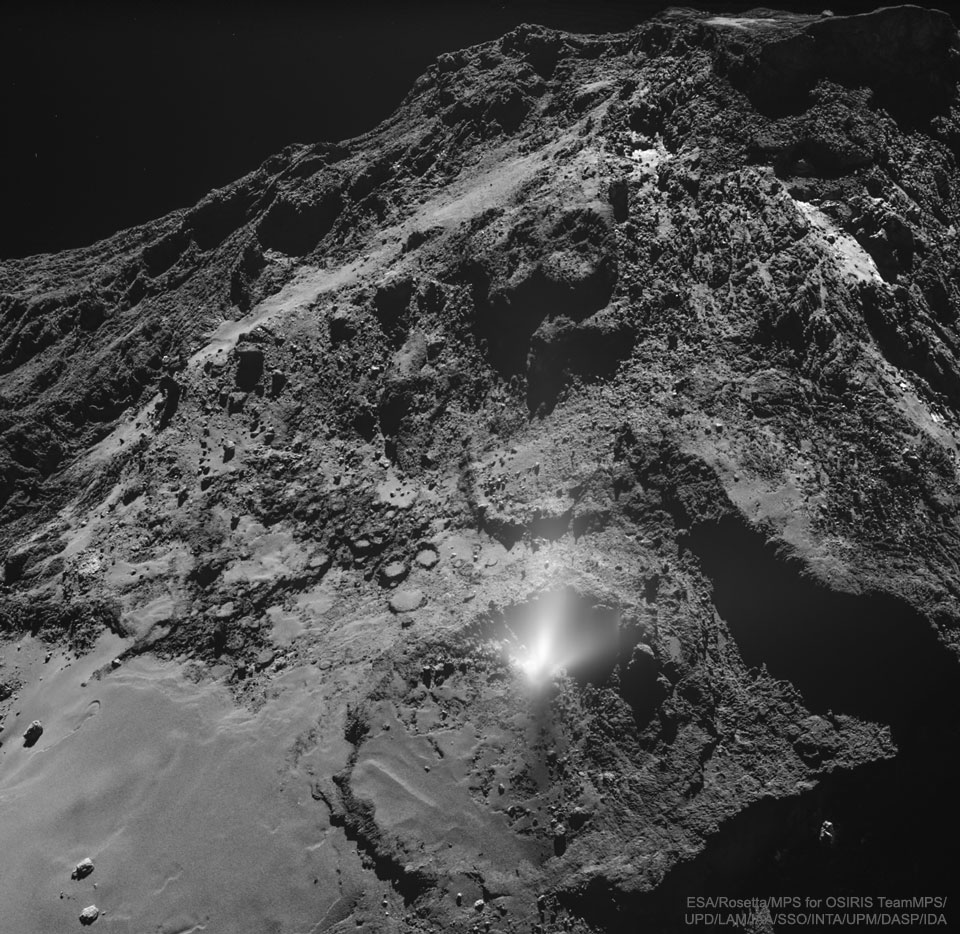
A Dust Jet from the Surface of Comet 67P
Image Credit & Copyright: ESA, Rosetta, MPS, OSIRIS; UPD/LAM/IAA/SSO/INTA/UPM/DASP/IDA
Explanation: Where do comet tails come from? There are no obvious places on the nuclei of comets from which the jets that create comet tails emanate. Last year, though, ESA's Rosetta spacecraft not only imaged a jet emerging from Comet 67P/Churyumov-Gerasimenko, but flew right through it. Featured is a telling picture showing a bright plume emerging from a small circular dip bounded on one side by a 10-meter high wall. Analyses of Rosetta data shows that the jet was composed of both dust and water-ice. The mundane terrain indicates that something likely happened far under the porous surface to create the plume. This image was taken last July, about two months before Rosetta's mission ended with a controlled impact onto Comet 67P's surface.

Monday, October 30, 2017

Astronomy Picture of the Day: October 30th of 2017

See Explanation.  Clicking on the picture will download
 the highest resolution version available.
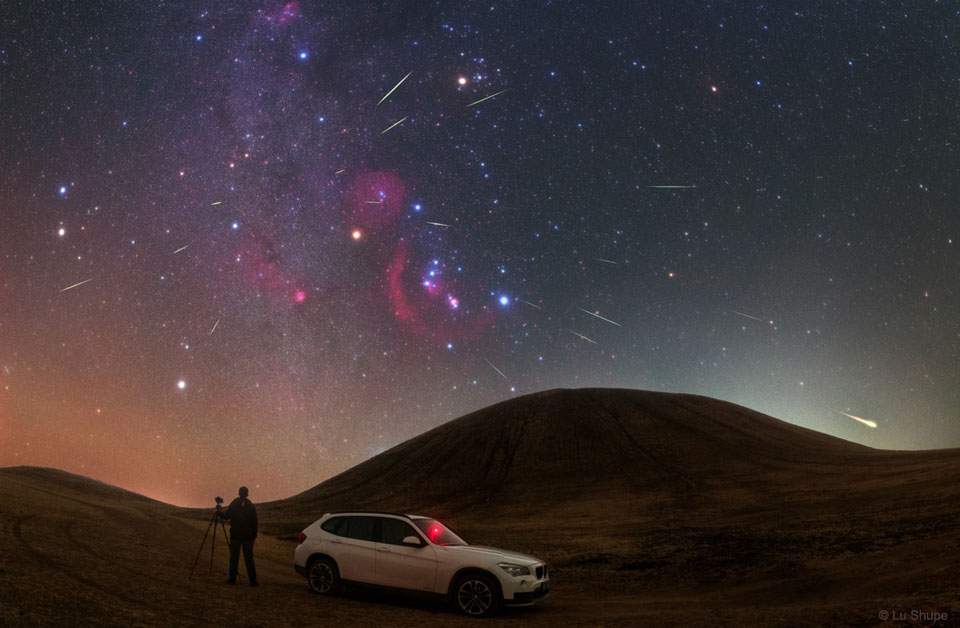
Orionid Meteors from Orion
Image Credit & Copyright: Lu Shupei
Explanation: Meteors have been shooting out from the constellation of Orion. This was expected, as October is the time of year for the Orionids Meteor Shower. Pictured here, over a dozen meteors were caught in successively added exposures last weekend over Wulan Hada volcano in Inner Mongolia, China. The featured image shows multiple meteor streaks that can all be connected to a single small region on the sky called the radiant, here visible just above and to the left of the belt of Orion, The Orionids meteors started as sand sized bits expelled from Comet Halley during one of its trips to the inner Solar System. Comet Halley is actually responsible for two known meteor showers, the other known as the Eta Aquarids and visible every May. Next month, the Leonids Meteor Shower from Comet Tempel-Tuttle should also result in some bright meteor streaks.

Sunday, October 29, 2017

Astronomy Picture of the Day: October 29th of 2017

See Explanation.  Clicking on the picture will download
 the highest resolution version available.
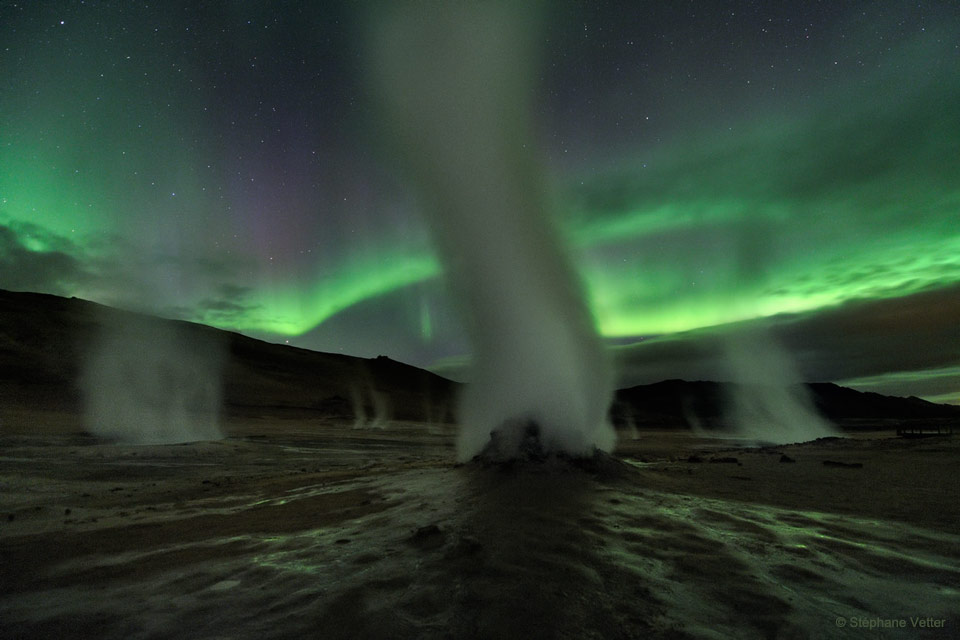
Night on a Spooky Planet
Image Credit & Copyright: Stéphane Vetter (Nuits sacrées)
Explanation: What spooky planet is this? Planet Earth of course, on a dark and stormy night in 2013 at Hverir, a geothermally active area along the volcanic landscape in northeastern Iceland. Geomagnetic storms produced the auroral display in the starry night sky while ghostly towers of steam and gas venting from fumaroles danced against the eerie greenish light. Tonight, there is also a chance for geomagnetic storms triggered by recent solar activity, so high-latitude skygazers should beware. Ghostly shapes may dance in your neighborhood pretty soon, too.

Friday, October 27, 2017

Astronomy Picture of the Day: October 27th of 2017

See Explanation.  Clicking on the picture will download
 the highest resolution version available.
Mirach's Ghost
Image Credit & Copyright: Kent Wood
Explanation: As far as ghosts go, Mirach's Ghost isn't really that scary. Mirach's Ghost is just a faint, fuzzy galaxy, well known to astronomers, that happens to be seen nearly along the line-of-sight to Mirach, a bright star. Centered in this star field, Mirach is also called Beta Andromedae. About 200 light-years distant, Mirach is a red giant star, cooler than the Sun but much larger and so intrinsically much brighter than our parent star. In most telescopic views, glare and diffraction spikes tend to hide things that lie near Mirach and make the faint, fuzzy galaxy look like a ghostly internal reflection of the almost overwhelming starlight. Still, appearing in this sharp image just above and to the left of Mirach, Mirach's Ghost is cataloged as galaxy NGC 404 and is estimated to be some 10 million light-years away.
Wednesday, October 25, 2017

Astronomy Picture of the Day: October 25th of 2017

See Explanation.  Clicking on the picture will download
 the highest resolution version available.
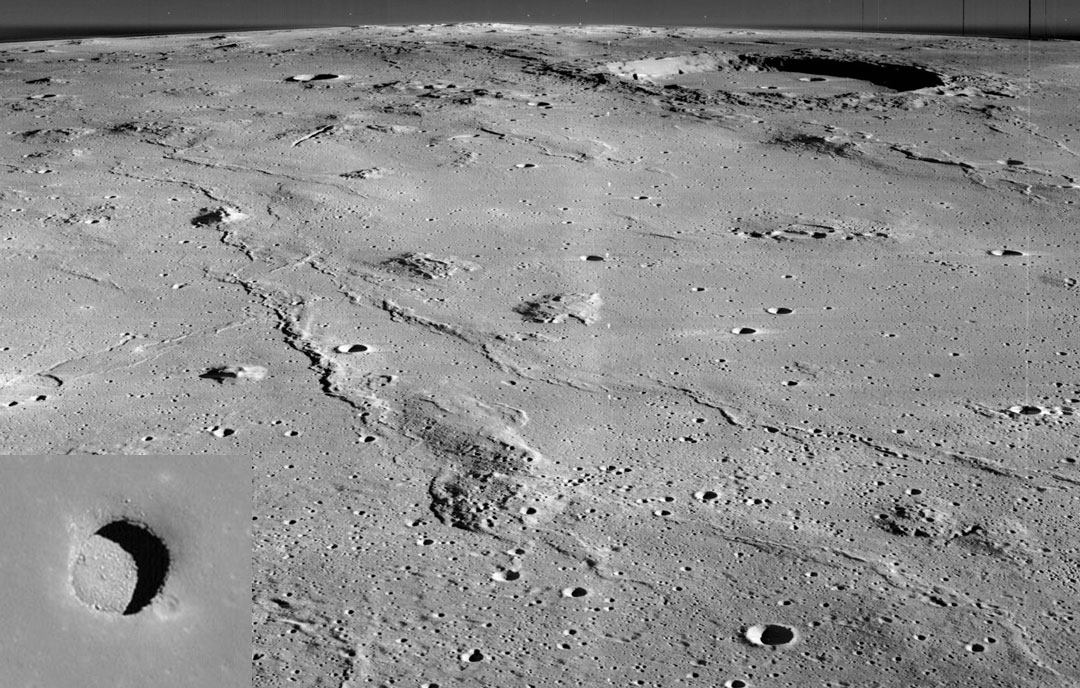
Marius Hills and a Hole in the Moon
Image Credit: NASA, Lunar Orbiter 2; Inset: Lunar Reconnaissance Orbiter
Explanation: Could humans live beneath the surface of the Moon? This intriguing possibility was bolstered in 2009 when Japan's Moon-orbiting SELENE spacecraft imaged a curious hole beneath the Marius Hills region on the Moon, possibly a skylight to an underground lava tube. Follow-up observations by NASA's Lunar Reconnaissance Orbiter (LRO) indicated that the Marius Hills Hole (MHH) visually extends down nearly 100 meters and is several hundred meters wide. Most recently, ground penetrating radar data from SELENE has been re-analyzed to reveal a series of intriguing second echoes -- indicators that the extensive lava tubes exist under Marius Hills might extend down even kilometers and be large enough to house cities. Such tubes could shelter a future Moon colony from large temperature swings, micro-meteor impacts, and harmful solar radiation. Potentially, underground lava tubes might even be sealed to contain breathable air. These lava tubes likely formed when lunar volcanos were active billions of years ago. Pictured, the surface of Marius Hills region was captured in the 1960s by NASA's Lunar Orbiter 2 mission, while an inset image of the MHH is shown from NASA's continuing LRO. Several volcanic domes are visible, while Marius Crater is visible on the upper right.

Tuesday, October 24, 2017

Astronomy Pictureof the Day: October 24th of 2017

See Explanation.  Clicking on the picture will download
 the highest resolution version available.
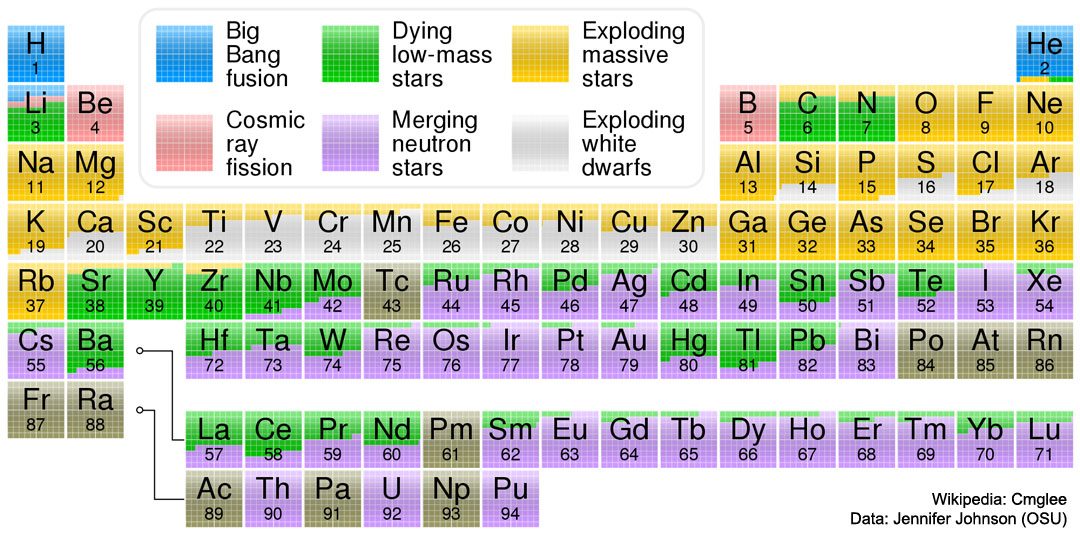
Where Your Elements Came From
Image Credit & License: Wikipedia: Cmglee; Data: Jennifer Johnson (OSU)
Explanation: The hydrogen in your body, present in every molecule of water, came from the Big Bang. There are no other appreciable sources of hydrogen in the universe. The carbon in your body was made by nuclear fusion in the interior of stars, as was the oxygen. Much of the iron in your body was made during supernovas of stars that occurred long ago and far away. The gold in your jewelry was likely made from neutron stars during collisions that may have been visible as short-duration gamma-ray bursts or gravitational wave events. Elements like phosphorus and copper are present in our bodies in only small amounts but are essential to the functioning of all known life. The featured periodic table is color coded to indicate humanity's best guess as to the nuclear origin of all known elements. The sites of nuclear creation of some elements, such as copper, are not really well known and are continuing topics of observational and computational research.

Monday, October 23, 2017

Astronomy Picture of the Day: October 23rd of 2017

See Explanation.
Moving the cursor over the image will bring up an annotated version.
Clicking on the image will bring up the highest resolution version
available.
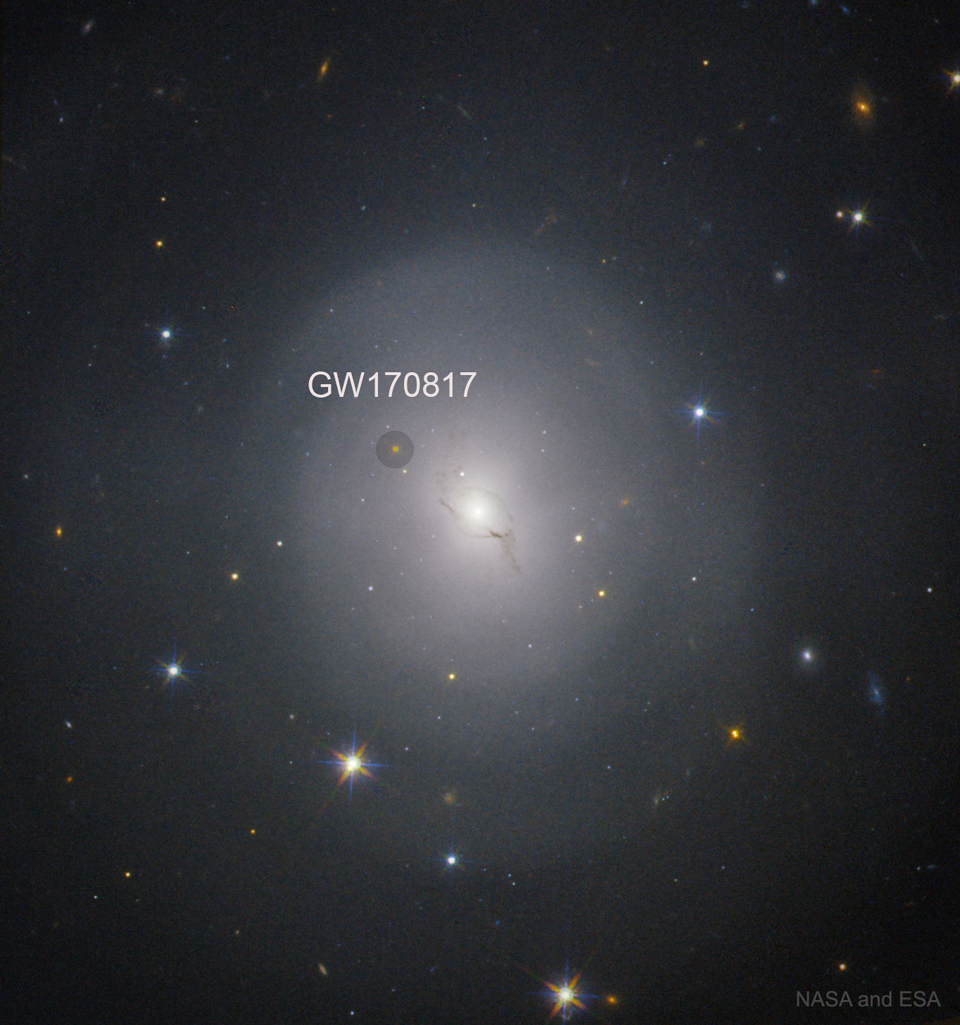
NGC 4993: The Galactic Home of an Historic Explosion
Image Credit: NASA & ESA
Explanation: That reddish dot -- it wasn't there before. It's the dot to the upper left of galaxy NGC 4993's center, do you see it? When scanning the large field of possible locations of an optical counterpart to the unprecedented gravitational wave event GW170817 in August, the appearance of this fading dot quickly became of historic importance. It pinpointed GW170817's exact location, thereby enabling humanity's major telescopes to examine the first ever electromagnetic wave counterpart to a gravitational wave event, an event giving strong evidence of being a short gamma-ray burst kilonova, the element-forming explosion that occurs after two neutron stars merge. The featured image of lenticular galaxy NGC 4993 by Hubble shows the fading dot several days after it was discovered. Analyses, continuing, include the physics of the explosion, what heavy elements formed, the similarity of the speeds of gravitational radiation and light, and calibrating a new method for determining the distance scale of our universe.

Sunday, October 22, 2017

Astronomy Picture of the Day: October 22nd of 2017

See Explanation.  Clicking on the picture will download
 the highest resolution version available.
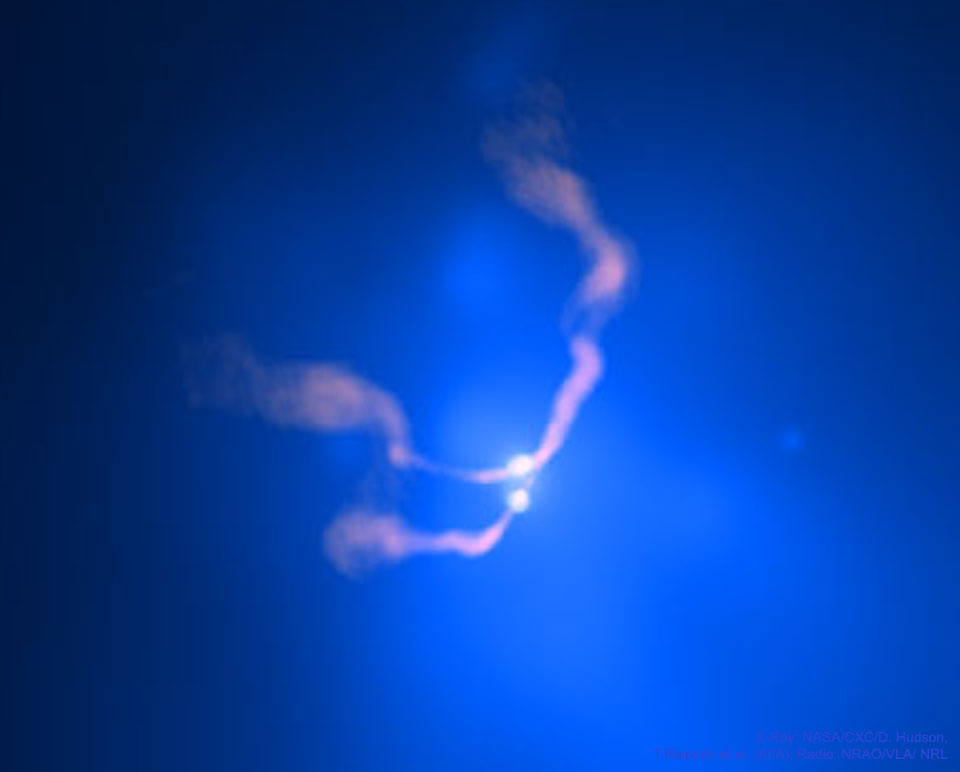
Two Black Holes Dancing in 3C 75
Image Credit: X-Ray: NASA/CXC/D. Hudson, T. Reiprich et al. (AIfA); Radio: NRAO/VLA/ NRL
Explanation: What's happening at the center of active galaxy 3C 75? The two bright sources at the center of this composite x-ray (blue)/ radio (pink) image are co-orbiting supermassive black holes powering the giant radio source 3C 75. Surrounded by multimillion degree x-ray emitting gas, and blasting out jets of relativistic particles the supermassive black holes are separated by 25,000 light-years. At the cores of two merging galaxies in the Abell 400 galaxy cluster they are some 300 million light-years away. Astronomers conclude that these two supermassive black holes are bound together by gravity in a binary system in part because the jets' consistent swept back appearance is most likely due to their common motion as they speed through the hot cluster gas at 1200 kilometers per second. Such spectacular cosmic mergers are thought to be common in crowded galaxy cluster environments in the distant universe. In their final stages the mergers are expected to be intense sources of gravitational waves.