Showing posts with label #pictureoftheday #astronomy #nasa. Show all posts

Tuesday, November 21, 2017

Astronomy Picture of the Day: November 21 of 2017

See Explanation.
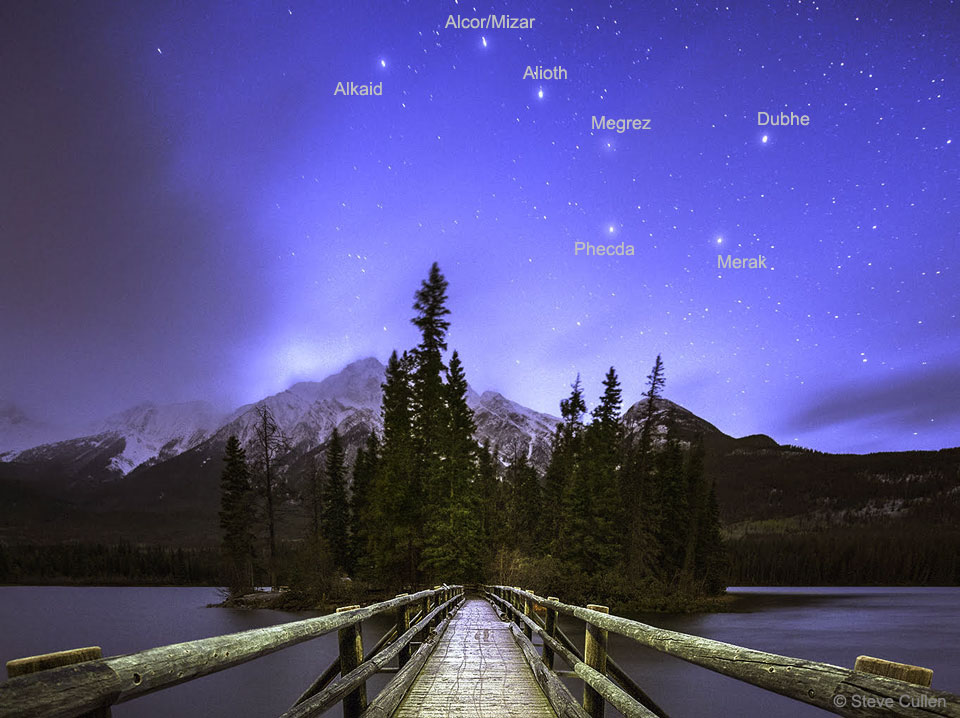
Moving the cursor over the image will bring up an annotated version.
Clicking on the image will bring up the highest resolution version
available.
Big Dipper over Pyramid Mountain
Image Credit & Copyright: Steve Cullen
Explanation: When did you first learn to identify this group of stars? Although they are familiar to many people around the world, different cultures have associated this asterism with different icons and folklore. Known in the USA as the Big Dipper, the stars are part of a constellation designated by the International Astronomical Union in 1922 as the Great Bear (Ursa Major). The recognized star names of these stars are (left to right) Alkaid, Mizar/Alcor, Alioth, Megrez, Phecda, Merak, and Dubhe. Of course, stars in any given constellation are unlikely to be physically related. But surprisingly, most of the Big Dipper stars do seem to be headed in the same direction as they plough through space, a property they share with other stars spread out over an even larger area across the sky. Their measured common motion suggests that they all belong to a loose, nearby star cluster, thought to be on average only about 75 light-years away and up to 30 light-years across. The cluster is more properly known as the Ursa Major Moving Group. The featured image captured the iconic stars recently above Pyramid Mountain in Alberta, Canada.
Friday, November 17, 2017

Astronomy Picture of the Day: November 17th of 2017

See Explanation.  Clicking on the picture will download
 the highest resolution version available.
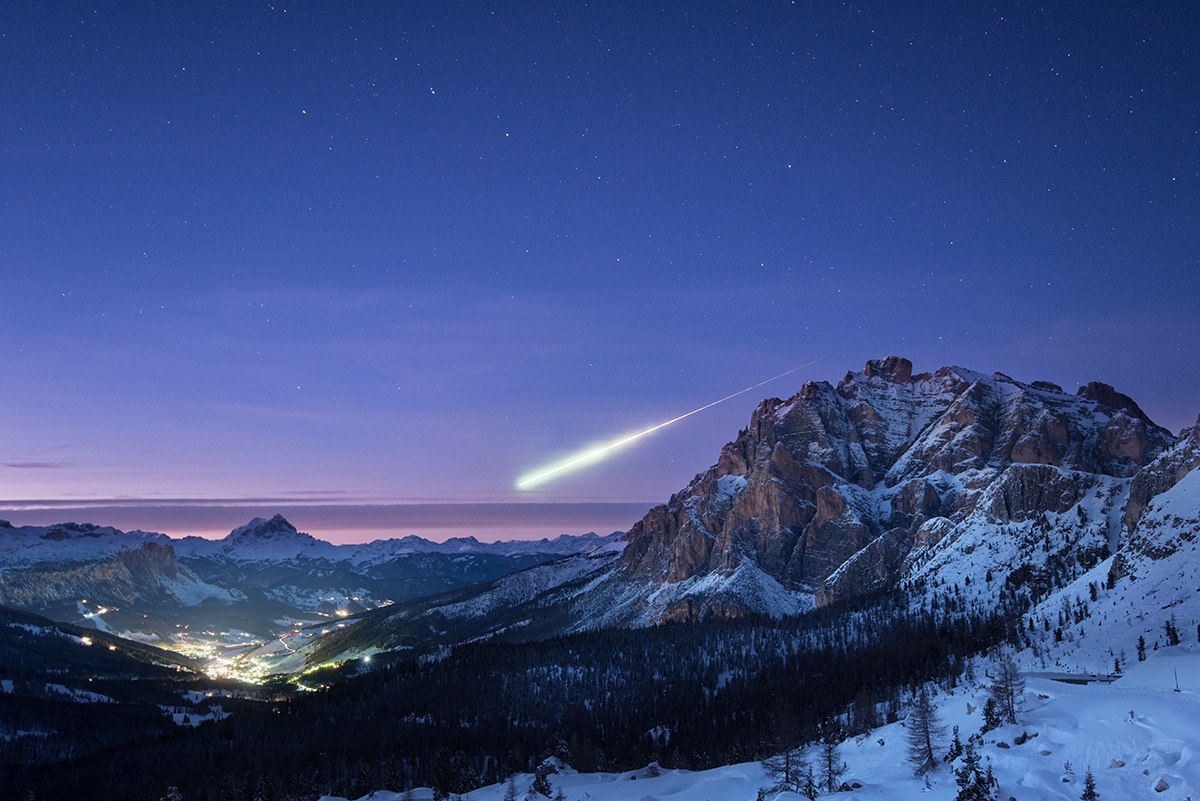
Major Fireball Meteor
Image Credit & Copyright: Ollie Taylor
Explanation: The sky glows with soft pinkish colors of fading twilight in this serendipitous mountaintop vista. Taken in subfreezing temperatures, the thoughtfully composed photo shows snowy, rugged peaks seen from a mountain pass on November 14. Below lies the village of La Villa, Alta Badia in Italy's Dolomite Alps. Above the nestled village lights, the constellation Ursa Major hangs over the northern horizon. But most stunning is the intense fireball meteor. It was captured during the camera's exposure by chance as it flashed east to west across the northern horizon, under Ursa Major's familiar Big Dipper asterism. In fact, sightings of this major fireball meteor were widely reported in European skies, the most reported fireball event ever for planet Earth's American Meteor Society and the International Meteor Organization. The meteor's measured track over Germany is consistent with its origin near the active radiant of November's Taurid Meteor Shower. Taurid meteors are associated with dust from Encke's comet.

Thursday, January 19, 2017

Astronomy Picture of the Day: January 19th of 2017

See Explanation.  Clicking on the picture will download
 the highest resolution version available.
The Elephant's Trunk Nebula in Cepheus
Image Credit & Copyright: Stephen Leshin
Explanation: Like an illustration in a galactic Just So Story, the Elephant's Trunk Nebula winds through the emission nebula and young star cluster complex IC 1396, in the high and far off constellation of Cepheus. Also known as vdB 142, the cosmic elephant's trunk is over 20 light-years long. This colorful close-up view includes image data from a narrow band filter that transmits the light from ionized hydrogen atoms in the region. The resulting composite highlights the bright swept-back ridges that outline pockets of cool interstellar dust and gas. Such embedded, dark, tendril-shaped clouds contain the raw material for star formation and hide protostars within. Nearly 3,000 light-years distant, the relatively faint IC 1396 complex covers a large region on the sky, spanning over 5 degrees. This dramatic scene spans a 1 degree wide field, about the size of 2 Full Moons.

Friday, November 18, 2016

Astronomy Picture of the Day: November 18th of 2016

See Explanation.  Clicking on the picture will download
 the highest resolution version available.
Philadelphia Perigee Full Moon
Image Credit & Copyright: Jerry Lodriguss (Catching the Light)
Explanation: A supermoon sets over the metropolis of Philadelphia in this twilight snapshot captured on November 14 at 6:21am Eastern Standard Time. Within hours of the Moon's exact full phase, that time does correspond to a lunar perigee or the closest point in the Moon's elliptical orbit around our fair planet. Slightly bigger and brighter at perigee, this Full Moon is still flattened and distorted in appearance by refraction in atmospheric layers along the sight-line near the horizon. Also like more ordinary Full Moons, it shines with the warm color of sunlight. Joined by buildings along the Philadelphia skyline, the perigee full moonlight is reflected in the waters of the mighty Cooper River.