Monday, December 7, 2015

National Geographic Photo of the Day: December 6th of 2015

Picture of monks releasing lanterns in Thailand
December 6, 2015

Fire Flies

Photograph by Joost Hardesmeets, National Geographic Your Shot
While exploring Chiang Mai, Thailand, in the days following the Loi Krathong festival, Your Shot member Joost Hardesmeets happened upon an enlightening moment. “I found a little temple with this beautiful pond next to it and discovered this amazing ceremony was about to take place,” Hardesmeets writes. “The small group ... was chanting beautifully and sort of finished the setting to a surreal spectacle I felt very special to be a part of."

Astronomy Picture of the Day: December 6th of 2015

See Explanation.  Clicking on the picture will download
 the highest resolution version available.
A Force from Empty Space: The Casimir Effect
Image Credit & Copyright: Umar Mohideen (U. California at Riverside)
Explanation: This tiny ball provides evidence that the universe will expand forever. Measuring slightly over one tenth of a millimeter, the ball moves toward a smooth plate in response to energy fluctuations in the vacuum of empty space. The attraction is known as the Casimir Effect, named for its discoverer, who, 55 years ago, was trying to understand why fluids like mayonnaise move so slowly. Today, evidence indicates that most of the energy density in the universe is in an unknown form dubbed dark energy. The form and genesis of dark energy is almost completely unknown, but postulated as related to vacuum fluctuations similar to the Casimir Effect but generated somehow by space itself. This vast and mysterious dark energy appears to gravitationally repel all matter and hence will likely cause the universe to expand forever. Understanding vacuum energy is on the forefront of research not only to better understand our universe but also for stopping micro-mechanical machine parts from sticking together.

Saturday, December 5, 2015

Buckethead - One of the best, most emotional versions of Soothsayer Live @ Gothic 9-28-2012

National Geographic Photo of the Day: December 5th of 2015

Picture of puffins resting on a rock in Iceland
December 5, 2015

Delayed Takeoff

Photograph by Manuel Schulz, National Geographic Your Shot
Your Shot member Manuel Schulz traveled to Iceland to capture some images of the country’s avian residents. After deciding to camp for an extra night in Látrabjarg, weather conditions changed on him. “The weather conditions looked great, but shortly before the light was getting nice, a thick wall of fog moved in from the sea and up the cliffs,” Schulz writes. “It was very impressive to see.” Schulz used a wide-angle lens and got close to the cliff’s edge to get this shot of these puffins as they waited for better hunting conditions.

Astronomy Picture of the Day: December 5th of 2015


Kepler Orrery IV
Video Credit & Copyright: Ethan Kruse (University of Washington)
Explanation: The exoplanet hunting Kepler mission's total for candidate and confirmed multiple planet systems stands at 1,705 worlds in orbit around 685 distant stars. Put all of those exoplanet orbits on the same scale and follow their relative orbital motions to get Kepler Orrery IV. To make the planets visible, their sizes aren't shown to scale. But orbits of the planets in the Solar System (dashed lines) are included to scale in the hypnotic video. Of course, Kepler uses planetary transits to detect exoplanets, looking for a slight dimming of light as the planet crosses in front of its star. In the time compressed video, Kepler's multiplanet system orbits are all oriented to put observed transits at the three o'clock position. The dervish-like movements highlight a stark contrast between most Kepler-discovered exoplanetary systems and our own. Planning an interstellar vacation? Be sure to check the scale at the upper left first. The color code indicates a planet's estimated equilibrium surface temperature based on its orbit size and parent star.

Friday, December 4, 2015

Bill Murray gives a surprising and meaningful answer you might not expect.

National Geographic Photo of the Day: December 4th of 2015

Picture of an amusement park ride inside a nuclear reactor in Germany
December 4, 2015

Take a Swing

Photograph by Luca Locatelli
This nuclear reactor at Kalkar, Germany, was finished just before the 1986 explosion at Chernobyl, Ukraine—and never used. It’s now an amusement park with a ride in what would have been the cooling tower. Fear of nuclear power spurred Germany’s transition.

Astronomy Picture of the Day: December 4th of 2015

See Explanation.  Clicking on the picture will download
 the highest resolution version available.
Cygnus: Bubble and Crescent
Image Credit & Copyright: Ivan Eder
Explanation: These clouds of gas and dust drift through rich star fields along the plane of our Milky Way Galaxy toward the high flying constellation Cygnus. Caught within the telescopic field of view are the Soap Bubble (lower left) and the Crescent Nebula (upper right). Both were formed at a final phase in the life of a star. Also known as NGC 6888, the Crescent was shaped as its bright, central massive Wolf-Rayet star, WR 136, shed its outer envelope in a strong stellar wind. Burning through fuel at a prodigious rate, WR 136 is near the end of a short life that should finish in a spectacular supernova explosion. recently discovered Soap Bubble Nebula is likely a planetary nebula, the final shroud of a lower mass, long-lived, sun-like star destined to become a slowly cooling white dwarf. While both are some 5,000 light-years or so distant, the larger Crescent Nebula is around 25 light-years across.

National Geographic Photo of the Day: December 3rd of 2015

Picture of the Shiva Tree Temple in Kauai, Hawaii
December 3, 2015

Supreme Sunlight

Photograph by Andrew Hara, National Geographic Your Shot
After spending time meditating at the Kauai Hindu Monastery in Hawaii, Your Shot member Andrew Hara came across this tucked-away statue of Shiva, one of the trinity of Hindu deities. “I ... [found] a hidden space where the statue of Shiva was gloriously placed under a glowing understory,” Hara writes. “I waited for the sunlight to shift through the tree canopy to bring out the glowing luster on the statue and surrounding space."

Astronomy Picture of the Day: December 3rd of 2015

See Explanation.  Clicking on the picture will download
 the highest resolution version available.
Enceladus: Ringside Water World
Image Credit: Cassini Imaging Team, SSI, JPL, ESA, NASA
Explanation: Saturn's icy moon Enceladus poses above the gas giant's icy rings in this Cassini spacecraft image. The dramatic scene was captured on July 29, while Cassini cruised just below the ring plane, its cameras looking back in a nearly sunward direction about 1 million kilometers from the moon's bright crescent. At 500 kilometers in diameter, Enceladus is a surprisingly active moon though, its remarkable south polar geysers are visible venting beyond a dark southern limb. In fact, data collected during Cassini's flybys and years of images have recently revealed the presence of a global ocean of liquid water beneath this moon's icy crust. Demonstrating the tantalizing liquid layer's global extent, the careful analysis indicates surface and core are not rigidly connected, with Enceladus rocking slightly back and forth in its orbit.

National Geographic Photo of the Day: December 2nd of 2015

Picture of people paddleboarding in Slovenia
December 2, 2015

Silhouettes at Sea

Photograph by Davorin Volavsek, National Geographic Your Shot
“[This] photo was taken alongside our Slovenian coast in early September,” writes Your Shot member Davorin Volavsek. “The sight of the sun setting behind the group seemed magical, and I just had to take the photo.”

Astronomy Picture of the Day: December 2nd of 2015


Golden Gate Sunset: Green Flash
Video Credit & Copyright: Alex Rivest; Music: Eureka by Huma-Huma
Explanation: The setting is San Francisco Bay, the time is sunset, and the bridge is the Golden Gate. What you are about to see is an unexpected double sunset ending with a rare green flash. Watch closely -- in the recorded time-lapse sequence, unusually warm air created by bridge traffic refracts sunlight toward the Earth, causing a superior image of the top of the Sun to form. This image will disappear -- marking the first "sunset" -- only after the main image has dipped below the deck. All the while, boats pass in the foreground, cars pass over the bridge, and clouds reflecting sunlight drift by in the distance. The scene ends with Earth's turbulent atmosphere itself creating a path that only higher-energy visible sunlight can traverse, making the last glimpse of our home star appear to flash green.

National Geographic Photo of the Day: December 1st of 2015

Picture of a snowy street scene in Istanbul
.
December 1, 2015

Snowed Out

Photograph by Olga Gamburg
“I was very fortunate to have witnessed a record-breaking snowstorm in Istanbul this past February,” writes Olga Gamburg of this image she captured in Turkey. “The city hasn't seen a beautiful white blanket like this in 28 years. After a three-hour journey on foot, because most of public transit and cabs stopped working, I was able to capture this perfect memory to take home with me.”

Astronomy Picture of the Day: December 1st of 2015

See Explanation.  Clicking on the picture will download
 the highest resolution version available.
Nebulae in Auriga
Image Credit & Copyright: Fritz Helmut Hemmerich
Explanation: Rich in star clusters and nebulae, the ancient constellation of the Charioteer (Auriga) rides high in northern winter night skies. Composed from narrow and broadband filter data and spanning nearly 8 Full Moons (4 degrees) on the sky, this deep telescopic view shows off some of Auriga's celestial bounty. The field includes emission region IC 405 (top left) about 1,500 light-years distant. Also known as the Flaming Star Nebula, its red, convoluted clouds of glowing hydrogen gas are energized by hot O-type star AE Aurigae. IC 410 (top right) is significantly more distant, some 12,000 light-years away. The star forming region is famous for its embedded young star cluster, NGC 1893, and tadpole-shaped clouds of dust and gas. IC 417 and NGC 1931 at the lower right, the Spider and the Fly, are also young star clusters embedded in natal clouds that lie far beyond IC 405. Star cluster NGC 1907 is near the bottom edge of the frame, just right of center. The crowded field of view looks along the plane of our Milky Way galaxy, near the direction of the galactic anticenter.

National Geographic Photo of the Day: November 30th of 2015

Picture of a lightning storm over Horseshoe Bend, Arizona
November 30, 2015

Striking View

Photograph by J. Cho
Lightning strikes beyond the rim of Arizona’s Horseshoe Canyon in this picture submitted by J. Cho. “It’s just amazing and beautiful,” Cho writes, noting that the movement of the storm in the background makes the scene come alive. Located within Glen Canyon National Recreation Area, the site is named for the distinctive bend of the Colorado River, which flows a thousand feet below the top of the cliffs.

Astronomy Picture of the Day: November 30th of 2015

See Explanation.  Clicking on the picture will download
 the highest resolution version available.
In the Center of Spiral Galaxy NGC 3521
Image Credit: ESA/Hubble & NASA and S. Smartt (Queen's University Belfast); Acknowledgement: Robert Gendler
Explanation: This huge swirling mass of stars, gas, and dust occurs near the center of a nearby spiral galaxy. Gorgeous spiral NGC 3521 is a mere 35 million light-years distant, toward the constellation Leo. Spanning some 50,000 light-years, its central region is shown in this dramatic image, constructed from data from the Hubble Space Telescope. The close-up view highlights this galaxy's characteristic multiple, patchy, irregular spiral arms laced with dust and clusters of young, blue stars. In contrast, many other spirals exhibit grand, sweeping arms. A relatively bright galaxy in planet Earth's sky, NGC 3521 is easily visible in small telescopes, but often overlooked by amateur imagers in favor of other Leo spiral galaxies, like M65 and M66.

National Geographic Photo of the Day: November 29th of 2015

Picture of people riding on top of train in Bangladesh
November 29, 2015

Riding High

Photograph by A.M. Ahad
The lush greenery of Bangladesh blurs past riders atop a train near Dhaka. The men are heading home to their villages, says Your Shot photographer A. M. Ahad, who captured the moment and submitted it to the 2015 National Geographic Photo Contest. "I am struck by how still and calm the riders are against the action of the moving train," photo editor Jeanne Modderman says. "[Ahad] captured this moment with great technique."

Astronomy Picture of the day: Novemeber 29th of 2015

See Explanation.  Clicking on the picture will download
 the highest resolution version available.
Dark Sand Cascades on Mars
Image Credit: HiRISE, MRO, LPL (U. Arizona), NASA
Explanation: They might look like trees on Mars, but they're not. Groups of dark brown streaks have been photographed by the Mars Reconnaissance Orbiter on melting pinkish sand dunes covered with light frost. The above image was taken in 2008 April near the North Pole of Mars. At that time, dark sand on the interior of Martian sand dunes became more and more visible as the spring Sun melted the lighter carbon dioxide ice. When occurring near the top of a dune, dark sand may cascade down the dune leaving dark surface streaks -- streaks that might appear at first to be trees standing in front of the lighter regions, but cast no shadows. Objects about 25 centimeters across are resolved on this image spanning about one kilometer. Close ups of some parts of this image show billowing plumes indicating that the sand slides were occurring even while the image was being taken.

National Geographic Photo of the Day: November 28th of 2015

Picture of Golden Gate Bridge, San Francisco, from the top of the bridge
November 28, 2015

Golden Gate Crossings

Photograph by Ross Barringer
For this new look at a San Francisco standard, Ross Barringer had to go high—very high. "I was very fortunate to be given the opportunity to take a 'tower tour' of the Golden Gate Bridge south tower," he writes. "Just as I was about to take the long elevator ride back down, I saw an approaching cargo ship and I quickly set up my tripod for what was my very last shot atop the iconic bridge."

Astronomy Picture of the Day: November 28th of 2015

See Explanation.  Clicking on the picture will download
 the highest resolution version available.
Rosetta and Comet Outbound
Image Credit & Copyright: Damian Peach/SEN
Explanation: Not a bright comet, 67P/Churyumov-Gerasimenko now sweeps slowly through planet Earth's predawn skies near the line-up of planets along the ecliptic. Still, this composite of telescopic images follows the comet's progress as it moves away from the Sun beyond the orbit of Mars, from late September (left) through late November (far right). Its faint but extensive coma and tails are viewed against the colorful background of stars near the eastern edge of the constellation Leo. A year ago, before its perihelion passage, the comet was less active, though. Then the Rosetta mission's lander Philae made its historic landing, touching down on the surface of the comet's nucleus.

National Geographic Photo of the Day: November 27th of 2015

Picture of a Victoria’s riflebird in a mating display, Queensland, Australia
November 27, 2015

Flirt in Training

Photograph by Dean Jewell
A young Victoria's riflebird practices a mating display he'll need when he's older and has undergone a color transformation: Adult males are velvety black with a bright blue-green crown. This juvenile was photographed in Daintree Rainforest in Queensland, one of the last strongholds of ancient Australian rain forests.

Astronomy Picture of the Day: November 27th of 2015

See Explanation.  Clicking on the picture will download
 the highest resolution version available.
Gravity's Grin
Image Credit: X-ray - NASA / CXC / J. Irwin et al. ; Optical - NASA/STScI
Explanation: Albert Einstein's general theory of relativity, published 100 years ago this month, predicted the phenomenon of gravitational lensing. And that's what gives these distant galaxies such a whimsical appearance, seen through the looking glass of X-ray and optical image data from the Chandra and Hubble space telescopes. Nicknamed the Cheshire Cat galaxy group, the group's two large elliptical galaxies are suggestively framed by arcs. The arcs are optical images of distant background galaxies lensed by the foreground group's total distribution of gravitational mass dominated by dark matter. In fact the two large elliptical "eye" galaxies represent the brightest members of their own galaxy groups which are merging. Their relative collisional speed of nearly 1,350 kilometers/second heats gas to millions of degrees producing the X-ray glow shown in purple hues. Curiouser about galaxy group mergers? The Cheshire Cat group grins in the constellation Ursa Major, some 4.6 billion light-years away.

Thursday, November 26, 2015

Joe Rogan Experience #725 - Graham Hancock & Randall Carlson

National Geographic Photo of the Day: Novemeber 26th of 2015

Picture of person walking on Eureka sand dunes in Death Valley National Park, California
November 26, 2015

Death Valley Dunes

Photograph by Kim Mitchell
The Eureka Dunes in Death Valley National Park offer an eerie soundtrack to visitors who decide to make their way up the sandy slopes—a mysterious phenomenon known as singing sand results in heavy bass notes and drones that sound like they come from airplanes. The booming sounds only add to the desolate beauty of the dunes, the tallest in California.

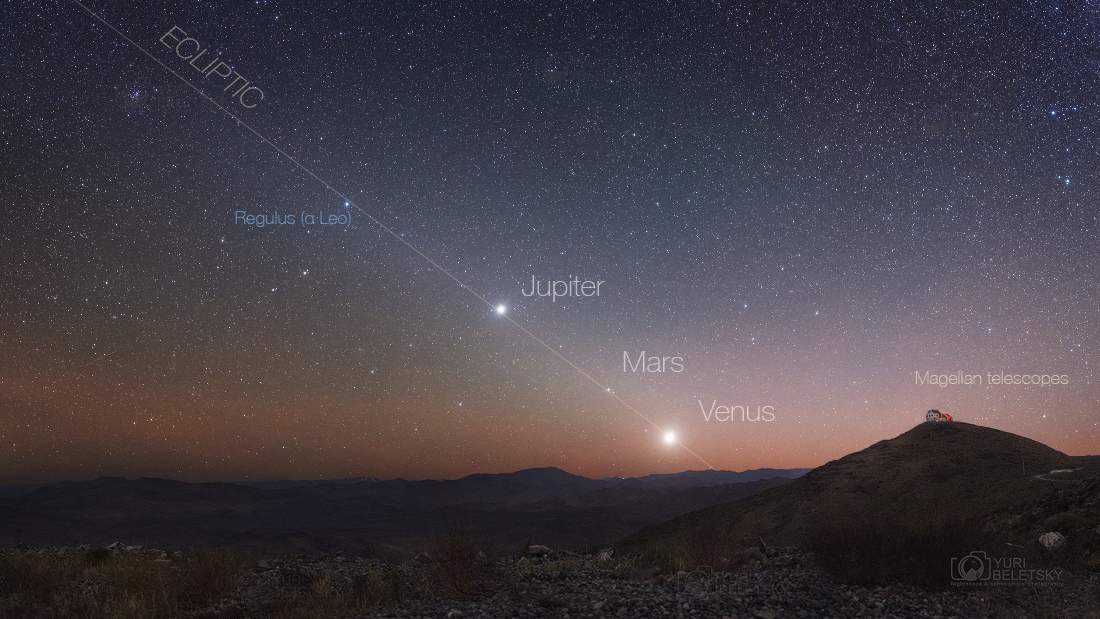
Astronomy Picture of the Day: November 26th of 2015

See Explanation.
Moving the cursor over the image will bring up an annotated version.
Clicking on the image will bring up the highest resolution version
available.
Planets of the Morning
Image Credit & Copyright: Yuri Beletsky (Carnegie Las Campanas Observatory, TWAN)
Explanation: Planet Earth's horizon stretches across this recent Solar System group portrait, seen from the southern hemisphere's Las Campanas Observatory. Taken before dawn it traces the ecliptic with a line-up familiar to November's early morning risers. Toward the east are bright planets Venus, Mars, and Jupiter as well as Regulus, alpha star of the constellation Leo. Of course the planets are immersed in the faint glow of zodiacal light, visible from the dark site rising at an angle from the horizon. Sometimes known as the false dawn, it's no accident the zodiacal light and planets both lie along the ecliptic. Formed in the flattened protoplanetary disk, the Solar System's planet's all orbit near the ecliptic plane, while dust near the plane scatters sunlight, the source of the faint zodiacal glow.